






The Lantent Structures
Paloma Gámez
Paloma Gámez defines herself as a painter, although her practice deliberately transcends the traditional boundaries of the medium. This condition does not operate as a negation of painting, but rather as an insistence on its constituent elements: support, material, and time of action. Her work is based on sustained research into materiality and process, understood as spaces where it is constructed and tensioned. Gámez attaches crucial significance to the terms colour, time and configuration, highlighting their interrelationships and the organic nature of her pieces.
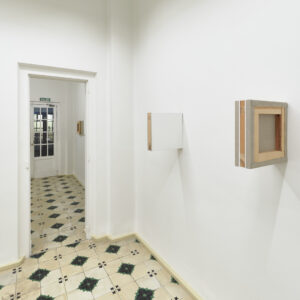
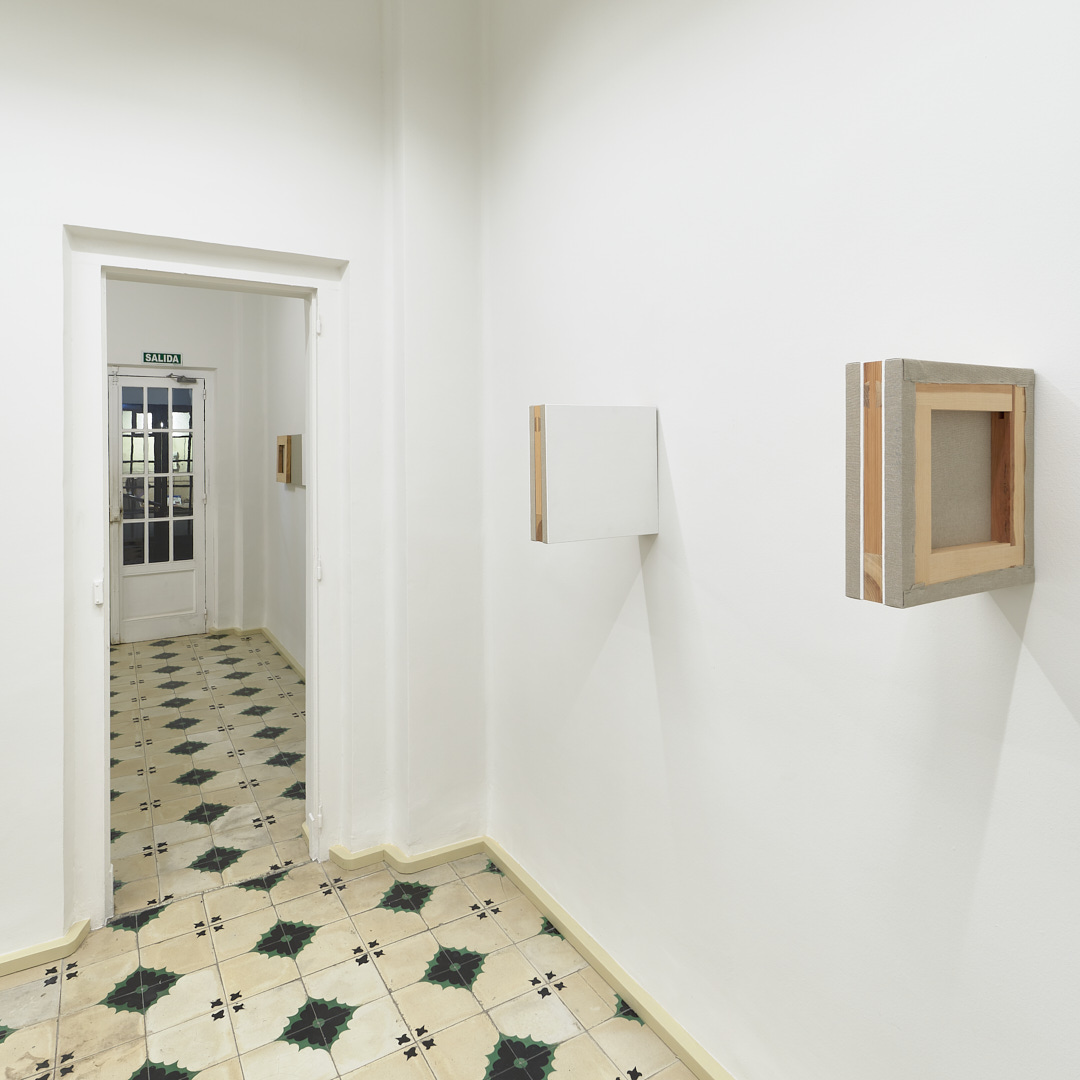
In Structures of the Latent, painting, form and negative space are articulated as variable states of the process. This triple articulation makes explicit the break with the traditional organisation of the painting and shifts painting towards an environmental dimension, where the visitor’s body is no longer external to the work. Likewise, there is an interest in the components: frames, canvas, primer, wooden wedges, margins, reverse side… as questions to the traditional hierarchies of the pictorial device.
Many lines of work in the 20th and 21st centuries have questioned the symbolic conditions of production, giving relevance to the parts that remained hidden from view. As Rosalind Krauss pointed out, modernity promoted a logic of self-analysis in which the artistic disciplines began to question their own materiality and legibility. In Gámez’s work, this legacy is formulated as a constant, almost silent material action, activated in every decision, rather than in an explicit theoretical gesture. (Krauss, 1996).
His interest in the concept of the ‘reverse’ organises much of his work and thinking. Far from operating symbolically, he chooses to shift attention to that which sustains the image without being seen. This interaction between the veiled and the visible manifests itself discreetly through a performativity that combines restrained gesture, repetition and material trace.
In other words, his practice is situated in a territory where the perceptible coexists with the structurally hidden. What lies silently between processes, layers of construction, remnants of materials and technical operations unfolds and rises: now visible, now imposing, now fully present.
The pieces in the exhibition move from two-dimensionality to silent three-dimensionality: achromatic surfaces with a minimalist appearance that, when viewed from different angles, reveal their internal complexity. The painting becomes a body, what it shows is affirmed, what it hides is intuited without being lost.
This gesture connects with what Michael Fried called the “theatricality” of the object, in that the work is not exhausted in its frontality. In the room, this condition is perceived in the need to surround the pieces, to pay attention to their sides and the shadows they cast, activating a bodily and temporal relationship with the viewer (Fried, 1998). In Gámez, this capacity is articulated through the use of media that provide visual lightness and an impeccable finish. The apparently untreated wood, the raw fabric, the absence of colour or a recognisable image, generate a perceptual experience based on closeness and a shift to a calm point of view.
Of particular relevance are the compositions made with wooden wedges, small and functional elements that often go unnoticed in the pictorial process. By shifting them from their primary function and arranging them in linear sequences on the wall, the artist transforms them into sculptural units that generate rhythms and intervals, activating a perception that is no longer purely visual, but spatial. This point is close to approaches typical of processual art and post-minimalism, where interest shifts from the final result to the material behaviour of the elements (Meyer, 2000).
The exhibition can be understood as a critique of the notion of a closed and self-sufficient work. Instead of presenting finished objects, it suggests open structures that constantly refer to their processual condition. The painting does not appear as an autonomous entity, but as the provisional result of a series of material decisions: stretching, assembling, cutting, hiding, showing. This emphasis on the act of making connects with the artist’s own ethics, committed to ongoing research.
Her work is situated in a hybrid territory between painting, sculpture and installation, defined by the media she uses and the relationships she establishes between form, space and viewer. The voids in the exhibition space, the alignments and distances in the gallery layout generate a perceptual choreography that turns the aesthetic experience into an exercise in slowing down the gaze.
Ultimately, Estructuras de lo latente (Structures of the Latent) by Paloma Gámez proposes a reflection on the status of the image. Her pieces emphasise the density of the object, the resistance of the materials and the relevance of time and gesture. What is perceived ceases to be narrative and becomes that which emerges from a sustained relationship with matter, time and space. The invisible ceases to be a void and acts as a latent force that conditions the form and the visitor’s experience. An exhibition that questions how we look and invites us to consider that which, while remaining hidden, makes the very existence of the work possible.
Beatriz Pérez_Nuevos Públicos